Step 4 of 7

4. Learning Content

Explanatory text

What are sensory disabilities?

An impairment is a condition that affects a sense, such as sight or hearing. A disability is what happens when the environment is not designed for that impairment and a barrier appears. This module uses "sensory disabilities" for the people it is about, and keeps "impairment" for the bodily condition.

Sensory disabilities most often affect hearing and sight, and there is wide variation within each group. People with sight loss range from those with low vision, who may use large print, magnification or good lighting, to those who are fully blind and may use Braille, audio or a white cane. People with hearing loss range from those who are hard of hearing, who may use hearing aids or captions, to Deaf people, many of whom use sign language and share a Deaf cultural and linguistic identity rather than seeing themselves as having a loss. Some people are deafblind, with a combination of hearing and sight disabilities. Two people in the same group can have very different access needs, so it is always best to ask the person what works for them.

The Social Model of Disability

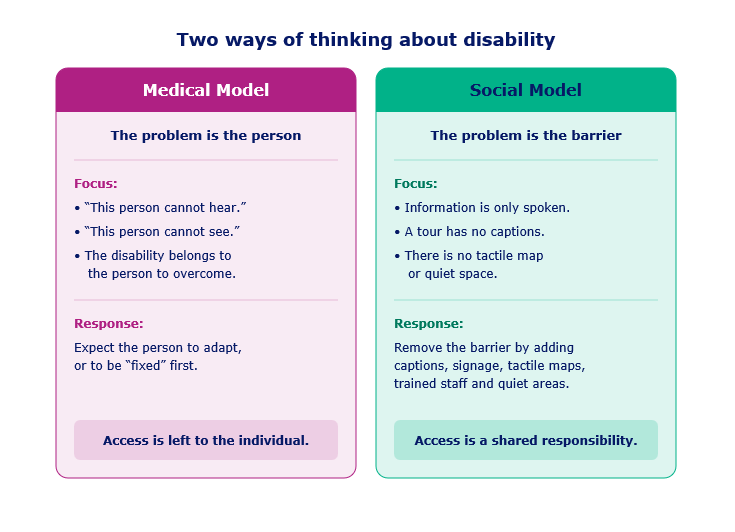
The Social Model distinguishes a person’s impairment from the disabling barriers created by society. A Deaf visitor, for example, may face a barrier when key information is available only as speech, without captions, sign language or another accessible alternative. When we change the environment, with clear signage, written and visual information, quiet areas and trained staff, the barrier is removed. This shifts the focus from changing the person to designing spaces and services that work for everyone.

A key aim of accessibility is independence. Cultural services should let visitors take part as independently as possible, rather than depending on staff, a companion or special arrangements each time.

Quiet areas are one example of an environmental change. They help visitors who can become overwhelmed by noise, bright light or crowds, including some autistic visitors and some people with sensory disabilities, by giving them a calm space to rest before continuing their visit.
Images and/or infographics

Two-column infographic comparing the Medical Model (the problem is the person) with the Social Model (the problem is the barrier in the environment). The full comparison is given in the text above.
The Social Model of Disability shifts the focus from the person to the barriers in the environment - and shows that removing those barriers is a shared responsibility.

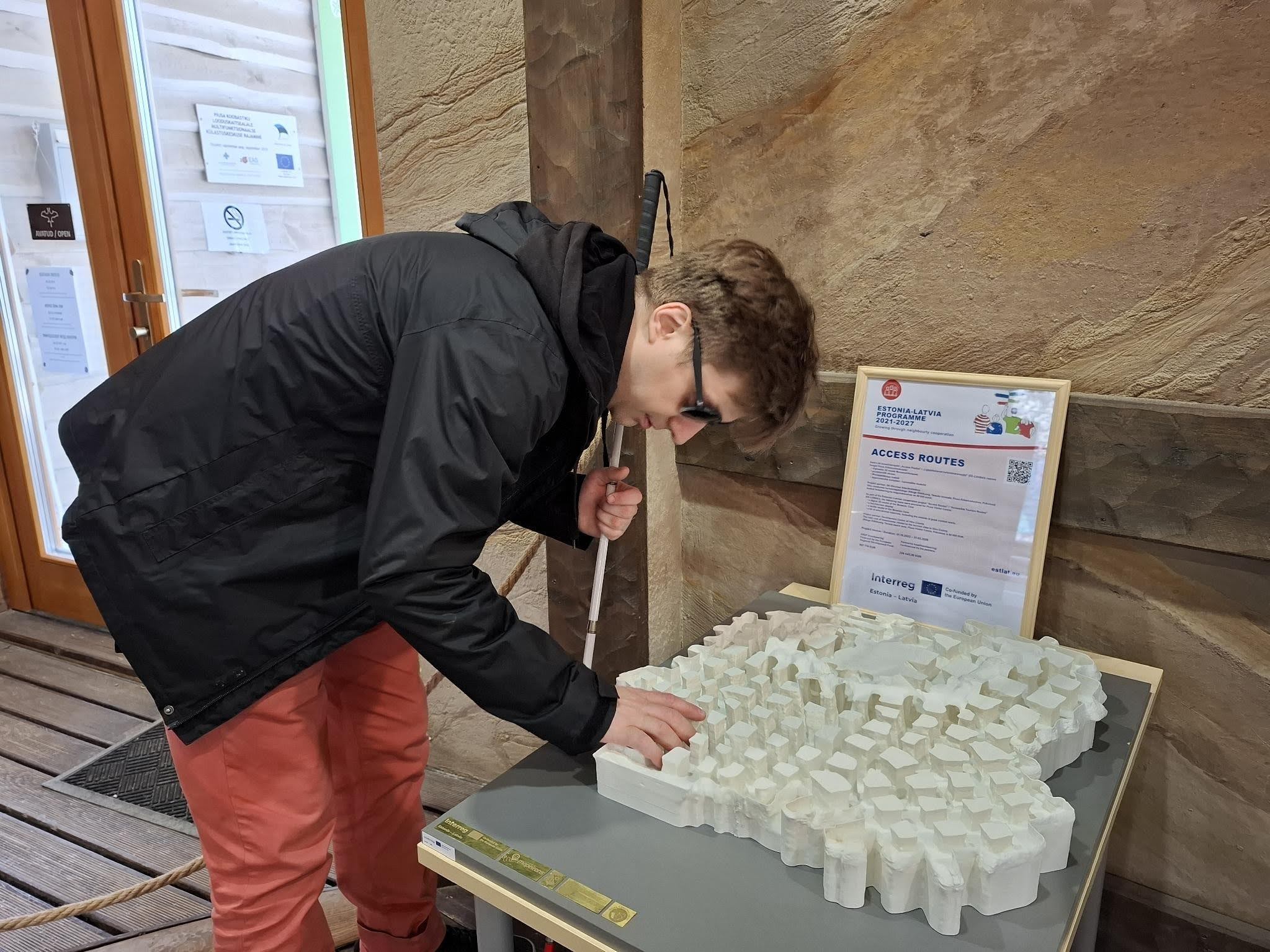
A young man who is blind, holding a white cane, leans over a table and explores a white tactile 3D model with his hand. The model is a raised representation of a cave system, showing its passages and structures so they can be read by touch. A framed information panel stands beside it at the entrance to a visitor centre.
A visitor reads a tactile 3D model of a cave system by touch. Offering information in a tactile format lets visitors who are blind or have low vision explore independently - a practical example of removing a barrier rather than expecting the person to adapt.

Videos
  1. https://www.ted.com/talks/roos_wattel_bridging_the_gap_between_the_deaf_and_hearing_community

In this TEDx talk, Deaf accessibility consultant Roos Wattel shares her experience of moving between the Deaf and hearing worlds, and describes the programme she set up to train Deaf people as museum guides in sign language – now running in museums across the Netherlands.

  1. https://www.ted.com/talks/chris_downey_design_with_the_blind_in_mind

In this TED talk, architect Chris Downey, who became blind as an adult, explains how designing spaces with blind people in mind – through sound, texture and clear layout – creates better environments for everyone, sighted or not.

Examples from the cultural sector

Latvian National Library (Riga, Latvia)

https://www.lnb.lv/en

The Latvian National Library shows how a large cultural venue can lower sensory barriers with simple steps: clear wayfinding, written and visual information at key points, and quieter reading areas away from busy zones. Smaller venues – a library, a community cultural centre or a small art gallery – can apply the same ideas at low cost, offering information in more than one format and a calm space for visitors who need it.

Useful links or external resources
  1. https://www.who.int/news-room/fact-sheets/detail/deafness-and-hearing-loss

World Health Organization fact sheet on deafness and hearing loss, with clear, plain-language information about types and levels of hearing disability.

  1. https://www.who.int/news-room/fact-sheets/detail/blindness-and-visual-impairment

World Health Organization fact sheet on blindness and vision disability, useful background for staff meeting visitors with low vision.